Stanford CS230: Career Advice for the AI Era
Contents
AI is rapidly changing software engineering: the cost of writing code continues to fall, the tasks engineers can complete are becoming more and more complex, and the bottleneck of product development is also shifting. This article summarizes five suggestions on AI career development shared in CS230 - understand changes, choose peers, measure efforts with output, lay a solid technical foundation, and pay attention to Small AI.
Source: Stanford CS230 · Autumn 2025 · Lecture 9: Career Advice in AI (Andrew Ng, Laurence Moroney, Kian Katanforoosh)
1. AI programming is pushing the bottleneck to “what to build”
The complexity of code logic and the ability to work continuously that AI can handle are increasing at a very fast rate. The judgment given in the lecture is that this ability will double approximately every two months.
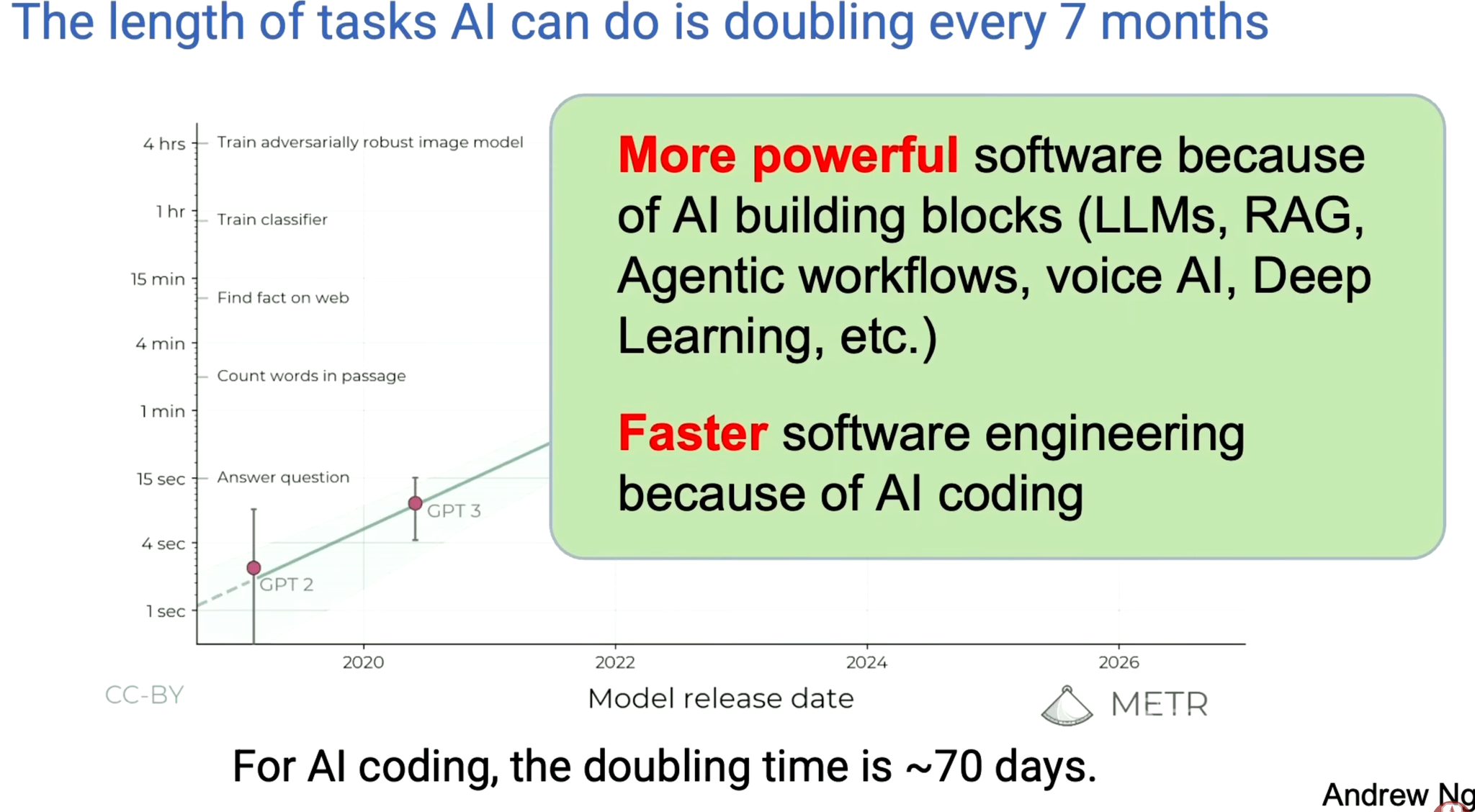
As writing code becomes faster and cheaper, the most scarce ability in software development is no longer just “how to implement it”, but gradually becomes:
What should be built? What problems are really worth solving?
In other words, the bottleneck is shifting from Engineering to Product Management. The ratio of engineers to product managers may continue to decline, even approaching 1:1. This is not to say that engineering capabilities are no longer important, but that the value of simply executing clear requirements is declining, and engineers who can define requirements and shape products will become more scarce.
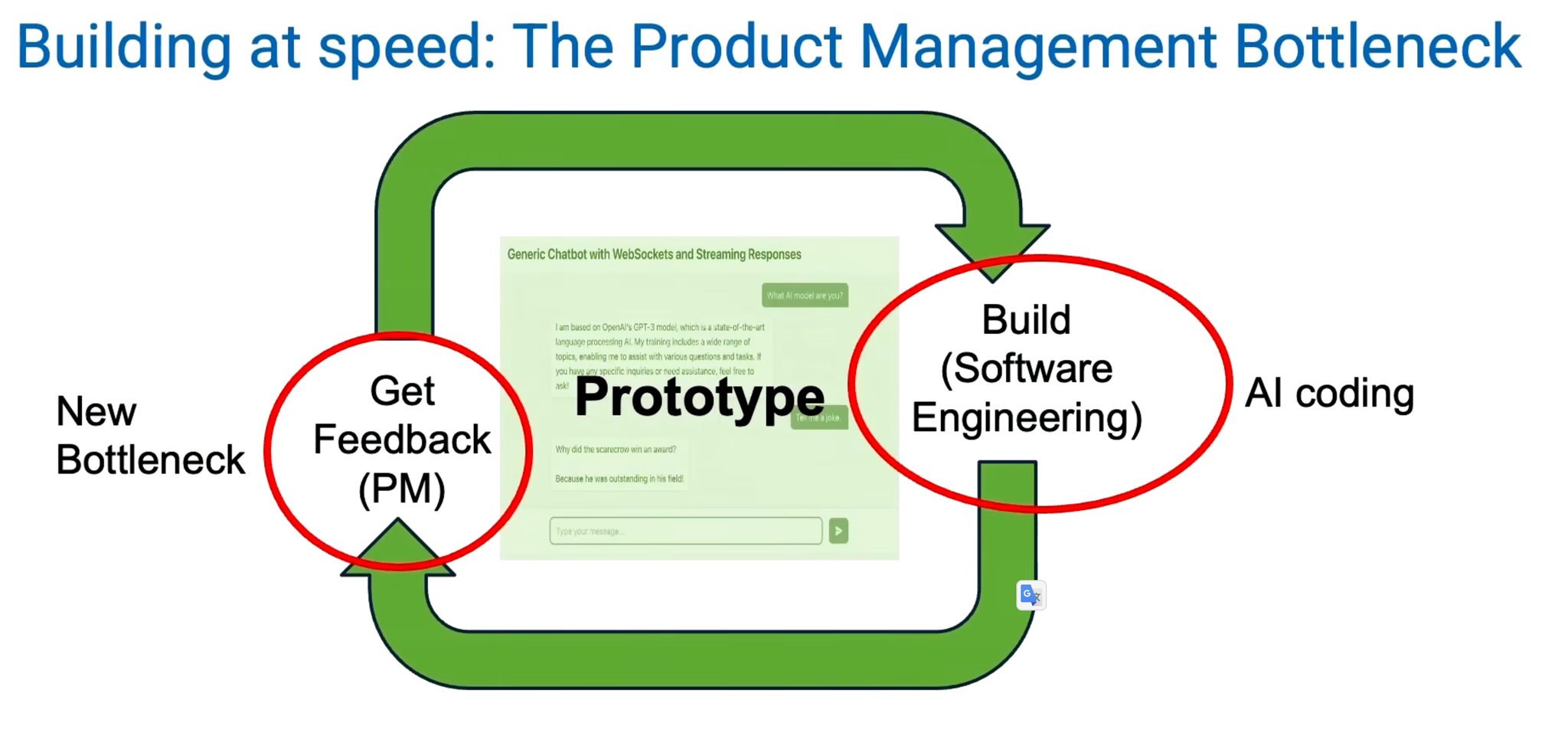
Engineers need to be closer to users
Traditional software engineering work tends to keep people inside the technology: discussing architecture, implementing functions, and fixing defects, but rarely facing users directly. After AI reduces implementation costs, what determines the success or failure of a product is often another set of capabilities:
- Actively communicate with users;
- Continuously obtain real feedback;
- Develop deep empathy for users’ problems;
- Quickly decide what to do and what not to do based on feedback;
- Shape vague requirements into usable products.
The person who will go further in the future may not be the person who types the fastest code, but the person who understands both engineering and users and iterates products quickly.
2. Choose the people you work with, not just the company brand
A strong indicator that affects a person’s growth rate and probability of success is the people around him. Sociological research often uses an intuitive example to explain this effect: if a person’s five close friends all smoke, the probability of him smoking will also increase significantly. Our standards of behavior, how quickly we learn, and how we judge are all shaped by the people around us.
The same goes for career choices. The lecture shared an example: a very good student got an offer from a popular AI laboratory, but the company never stated which team he would join. He thought he would be involved in exciting AI projects, but instead was assigned to maintain a back-end Java payment processing system. He became very frustrated and left the company after about a year because the job content was so different from what he expected.
This example reminds us that when choosing a job, we should not just look at the halo of the company or laboratory, but we should also try to understand:
- Who you will work with every day;
- Who is the person directly responsible;
- Is the team hard-working, smart and knowledgeable?
- Whether the project you are actually responsible for excites you;
- The team’s ability to provide high-quality feedback and drive their own growth.
Working with good people for a long time is often more important than entering a company with a well-known brand but unknown work content and team.
3. The measure of hard work is output, not hours worked
Today, encouraging others to “work hard” sometimes seems inappropriate. It is true that everyone is at a different stage of life: family responsibilities, physical conditions or other practical reasons may prevent a person from being able to invest at a high intensity for the time being. This should be respected and supported.
But on the other hand, great results often require long-term and dedicated investment. Successful PhD students tend to be very hardworking, and it’s not uncommon to be working on experiments at two in the morning. If you happen to be at a stage in your life where you can fully commit, there are still plenty of opportunities worth taking advantage of right now.
The key is not to measure effort by “how long you sit” but by effective output:
- How much time is actually spent advancing important issues;
- What verifiable results have been produced;
- Whether you have found an area where you can continue to create value;
- Is today’s work accumulating capabilities for the next stage?
A quote from the lecture sums up this output orientation well:
Don’t let your output be for the job you have; let your output be for the job you want.
Don’t match your output to your current position, match it to the next job you hope to get.
4. The market is cold, but those with strategies still have opportunities
There are some real pressures on the job market right now:
- Recruitment for entry-level positions has slowed significantly;
- Mass layoffs continue to dominate the news;
- Entry-level positions become more scarce;
- Competition for jobs is becoming increasingly fierce.
These changes should not be taken lightly, but they do not mean opportunities are gone either. The field of AI is still changing rapidly, and there are still plenty of opportunities for those who can adjust course in time and adopt the right strategies.
Make complex technology “ordinary”
An effective way to build a technical foundation is to take the initiative to make complex concepts mundane—mundane, concrete, and everyday.
When encountering a concept that seems profound, don’t be satisfied with reciting terms or formulas, but continue to ask:
- Can you explain it in ordinary language?
- What problem does it solve?
- After removing the terminology, what is the core mechanism?
- Can you use an everyday example to help non-experts understand?
- How much does the other party really need to understand?
When you can explain complex technology in a detailed and down-to-earth manner according to the needs of the audience, it usually means that you truly understand it. This capability both strengthens the technical foundation and improves communication, teaching, and product decisions.
5. A trend worthy of attention: Small AI and underlying computing power
The trend judgment given at the end of the lecture is: Small AI, that is, client-side AI and small models, may become the next important growth point.
The cloud large model has powerful capabilities, but the client-side model also has its own advantages:
- Lower request latency;
- Better privacy protection;
- It can still be used in weak network or offline environments;
- Reduce cloud inference costs;
- Can be deeply integrated with specific equipment and personal scenes.
The hardware architecture of mobile terminals is also evolving rapidly. The lecture specifically mentioned SME (Scalable Matrix Extension): this type of underlying capability allows matrix calculations to run more efficiently and makes it possible to put more AI workloads on the local CPU.
For engineers, this means that it’s not just larger models that deserve attention, but also model compression, quantization, end-side inference, compiler optimization, hardware architecture, and energy efficiency.
Summary
Professional competitiveness in the AI era can be summarized into five points:
- Not only learn how to implement it, but also learn to judge what should be built;
- Choose teams and colleagues who can inspire you and help you grow;
- Measure efforts with effective output and let the output point to the desired future;
- Make complex technologies simple and concrete, and establish a truly solid foundation;
- In addition to large models, continue to pay attention to opportunities in Small AI and underlying computing power.
AI makes it easier to implement products and makes judgment, empathy, communication skills and environmental choices more important. Technology is still the foundation, but what really widens the gap is how a person uses technology to discover problems, understand users, and continue to create value.
Author zhengxz
LastMod 2026-03-23