Anthropic Agent Evolution II: Context Reset and Structured Handoff
Contents
The central tension in long-running work is not whether a model can write code. It is that a task may last hours or days while every context window is finite. Replaying the entire history eventually creates both capacity and noise problems.
Anthropic’s first long-running agent harness answered with a simple principle: reset conversational context, but externalize project state into structured artifacts that the next agent can recover.
Series: I. From Workflows to Agents · II. Context Reset and Structured Handoff · III. Planner–Generator–Evaluator · IV. Managed Agent Runtime
1. Why Is Compaction Not Enough?
Context compaction summarizes older conversation while keeping the same agent and session. It is continuous, inexpensive, and operationally simple, but it does not guarantee a clean slate:
- a summary can omit details whose importance becomes clear only later;
- stale plans, incorrect assumptions, and noise can survive compression;
- the model may still sense an approaching limit and wrap up prematurely;
- a new turn may see substantial progress and incorrectly declare victory.
Context reset clears the window and starts a fresh agent. The cost is that recovery now depends on a complete handoff.
| Approach | Advantages | Risks |
|---|---|---|
| Context compaction | Preserves continuity; simpler orchestration; lower latency and token overhead | Summaries may distort state; stale assumptions survive; no clean slate |
| Context reset | Removes accumulated noise; each run can refocus | Requires excellent handoff artifacts; adds orchestration and recovery work |
The techniques can coexist: compact within a phase, then reset at meaningful boundaries or when context quality degrades.
2. Two Roles: Initializer and Coding Agent
2.1 Initializer Agent
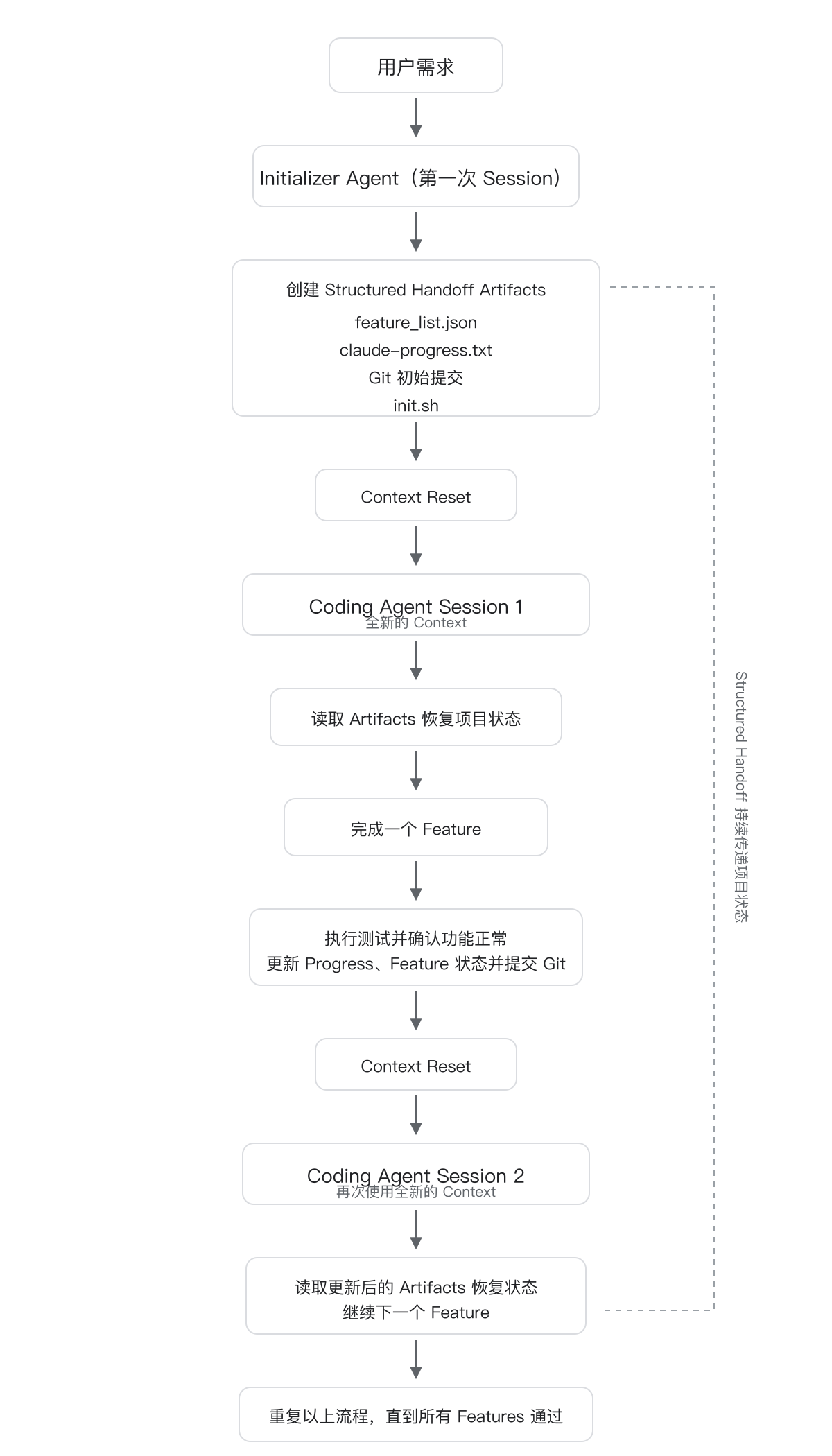
The first run establishes the environment instead of rushing into implementation:
feature_list.jsonrecords complete features, acceptance steps, and status.claude-progress.txtrecords progress, test results, known issues, and next steps.- An initial Git commit creates a traceable and recoverable baseline.
init.shstandardizes startup and basic verification.
The feature list turns “finish the product” from a subjective impression into external facts that begin in a failing state and must be verified one by one.
2.2 Coding Agent
Every fresh context follows the same protocol:
- read the directory, Git history, progress log, and feature list;
- run
init.shand a basic end-to-end check; - choose one high-priority failing feature;
- implement and validate it in the real environment;
- change
passesonly when evidence is sufficient; - write progress, commit, and leave a clean state.
3. What Does a Structured Handoff Carry?
A strong handoff is not a vague prose summary. It is a set of mutually checking state layers:
- Spec / feature list says what the complete target is.
- Progress log says what the previous run attempted and where risks remain.
- Git history says what actually changed.
- Code and tests are the final source of truth for current system behavior.
- Startup scripts say how to restore a verifiable environment.
Context reset cleans the model’s temporary workspace; structured handoff preserves durable project state outside the model.
Fresh context + durable artifacts + ground-truth tests = sustainable long-running execution
4. Why One Feature at a Time?
A bare agent tends to one-shot an application, leaving a half-built state when context expires. The next agent cannot easily reconstruct the design intent or determine which parts are trustworthy.
Incremental work constrains each session to a mergeable state: the diff is understandable, completion maps to executable checks, and the session does not leave unrelated damage behind.
This resembles an effective engineering handoff. Teams do not share every conversation; they share issues, commits, tests, and a runnable system.
5. Testing Is Part of the Handoff
Model self-evaluation is insufficient. Unit tests and curl can still miss broken user journeys. For web applications, an agent should use browser automation to click, type, and observe UI and backend state as a user would.
“Tests passed” therefore cannot be prose in a progress file. It must correspond to reproducible steps and environmental feedback. Each new session begins with smoke tests; if the previous session damaged the baseline, repair comes before new feature work.
6. Limits of This Generation
Initializer + coding agent solves cross-context continuity, but not judgment:
- generators remain too optimistic about their own work;
- subjective quality does not fit a single pass/fail field;
- complex applications need checks and balances across planning, implementation, and QA;
- harness components can become obsolete as models improve.
That leads directly to the next stage: separating the agent doing the work from the agent judging it in a Planner–Generator–Evaluator system.
Sources
Author zhengxz
LastMod 2026-09-12